Good news for cell phone component manufacturers as ABI Reserach reports that the mobile handset market is set for a stellar performance in 2010. 3Q-2010 is up 346.2 million in handset shipments. For the first three quarters of the year, YoY growth has been hovering around 20%. �This is a remarkable feat, irrespective of the rebound effect following the deferred handset purchases during the economic recession,� says Jake Saunders, VP for forecasting at ABI Research. �Layer on �smartphone-envy� and you have a recipe for high handset volumes.�
This rebound is having some interesting consequences:
1) Component manufacturers have never had it so good. Nokia in particular reported a hardware crunch, especially with displays (e.g. AMOLED) and semiconductor components for low-cost handsets. Nokia�s leading market-share in this segment has increased Nokia�s exposure to the component crunch.
2) Vendors that have strong portfolios in smartphones (RIM, Apple, HTC and Motorola) have seen their growth in market-share outperform the market. This effect is likely to continue into 4Q-2010 and 2011.
3) Unless Nokia can resolve its component resourcing challenges, it is likely to be supply-constrained again in 4Q-2010, a quarter that typically equates to 30% of annual handset sales. �Nokia�s market-share could well come under further pressure,� adds Kevin Burden, VP and practice director for mobile devices.
4) Handset vendors with greater in-house ability to source their own components (e.g. Samsung and LG) will be able to take advantage of the market opportunity to expand volumes.
5) Typically a handset boom period is followed by a market softening as customers wait for the next �must have� handset feature innovation to make its way to the market. We should not be unduly worried. There is still considerable room for innovation in the smartphone sector, not just �feature innovation� but also �cost reduction innovation,� which should keep customers keen.
The spotlight has to be put on Apple and RIM: they increased their market-shares to 4.1% and 4% respectively. While Samsung did manage to demonstrate quarterly growth (to 20.6%), other vendors contracted: Nokia (31.9%), LG (8.2%), Sony-Ericsson (3%), Motorola (2.6%).
From a volume point of view, ABI reported that total shipments of mobile handsets are expected to be 1.34 billion by YE-2010 and should maintain their momentum all the way to 2015, which will see more than 1.7 billion in handset shipments.
�The Asia-Pacific region currently makes the largest contribution to global handset sales,� says ABI Research industry analyst Celia Bo. �Handset sales are projected to increase 9% this year compared to 2009, and will account for 38% of total shipments. China is clearly a major source of handset demand, but it is not the only one. India and Indonesia are also expanding their domestic demand.�
The Indian handset market is expected to grow from 84.3 million handsets in 2009 to 104 million in 2010, a Year-over-Year growth of 24%. Similarly, Indonesia is not insignificant. Many of its 240 million people confidently purchased 33 million handsets in 2009 and that figure is expected to surpass 37 million by the end of 2010. Both markets have traditionally been fertile ground for Nokia distributors and dealers. In those markets, the Finnish manufacturer has enjoyed a market-share well above its global average.
Nokia has been very effective in producing ultra-low cost handsets that are robust and user-friendly and at the right price-point. However, Nokia has seen its market-share steadily eroded in the mid- to high tiers as India�s and Indonesia�s aspiring middle classes purchase high-end feature phones and smartphones. Vendors such as Samsung, LG and RIM have been net beneficiaries.
�A number of local handset vendors such as Micromax and Spice Mobile in India, and Nexian and SPC Mobile in Indonesia, are intent on catering to low-end and mid-tier end-users,� notes VP and practice director Kevin Burden. �Their game-plan is to push the envelope on providing increasingly feature-rich handsets at aggressive price-points.�

Find your polling place and follow the US Election on the go
The United States midterm election is on Tuesday, November 2, and we encourage all eligible US citizens to get out and vote. We’ve made it easy to find your polling place and follow election news by visiting our Election Center mobile site at m.google.com/elections on your Android-powered phone or iPhone.


So come Tuesday, let your mobile phone guide you to your polling place, and let sanity guide your vote!


Enter the address where you’re registered to vote, and we’ll show you a Google Map of your polling place. The Election Center site also has information about candidates running for office in your area.
�Wireless� humans could form backbone of new mobile networks
Members of the public could form the backbone of powerful new mobile internet networks by carrying wearable sensors.
According to researchers from Queen�s University Belfast, the novel sensors could create new ultra high bandwidth mobile internet infrastructures and reduce the density of mobile phone base stations.
The engineers from Queen�s renowned Institute of Electronics, Communications and Information Technology (ECIT), are working on a new project based on the rapidly developing science of body centric communications.
Social benefits from the work could include vast improvements in mobile gaming and remote healthcare, along with new precision monitoring of athletes and real-time tactical training in team sports.
The researchers at ECIT are investigating how small sensors carried by members of the public, in items such as next generation smartphones, could communicate with each other to create potentially vast body-to-body networks (BBNs).
The new sensors would interact to transmit data, providing �anytime, anywhere� mobile network connectivity.
Dr Simon Cotton (Dr. Cotton wrote the lead story for the MWJ 2010 August Supplement) , from ECIT�s wireless communications research group said: �In the past few years a significant amount of research has been undertaken into antennas and systems designed to share information across the surface of the human body. Until now, however, little work has been done to address the next major challenge which is one of the last frontiers in wireless communication � how that information can be transferred efficiently to an off-body location.
�The availability of body-to-body networks could bring great social benefits, including significant healthcare improvements through the use of bodyworn sensors for the widespread, routine monitoring and treatment of illness away from medical centres. This could greatly reduce the current strain on health budgets and help make the Government�s vision of healthcare at home for the elderly a reality.
�If the idea takes off, BBNs could also lead to a reduction in the number of base stations needed to service mobile phone users, particularly in areas of high population density. This could help to alleviate public perceptions of adverse health associated with current networks and be more environmentally friendly due to the much lower power levels required for operation.�
Dr Cotton has been awarded a prestigious joint five-year Research Fellowship by the Royal Academy of Engineering and the Engineering and Physical Research Council (EPSRC) to examine how the new technology can be harnessed to become part of everyday life.
He added: �Our work at Queen�s involves collaborating with national and international academic, industrial and institutional experts to develop a range of models for wireless channels required for body centric communications. These will provide a basis for the development of the antennas, wireless devices and networking standards required to make BBNs a reality.
�Success in this field will not only bring major social benefits it could also bring significant commercial rewards for those involved. Even though the market for wearable wireless sensors is still in its infancy, it is expected to grow to more than 400 million devices annually by 2014.�
According to researchers from Queen�s University Belfast, the novel sensors could create new ultra high bandwidth mobile internet infrastructures and reduce the density of mobile phone base stations.
The engineers from Queen�s renowned Institute of Electronics, Communications and Information Technology (ECIT), are working on a new project based on the rapidly developing science of body centric communications.
Social benefits from the work could include vast improvements in mobile gaming and remote healthcare, along with new precision monitoring of athletes and real-time tactical training in team sports.
The researchers at ECIT are investigating how small sensors carried by members of the public, in items such as next generation smartphones, could communicate with each other to create potentially vast body-to-body networks (BBNs).
The new sensors would interact to transmit data, providing �anytime, anywhere� mobile network connectivity.
Dr Simon Cotton (Dr. Cotton wrote the lead story for the MWJ 2010 August Supplement) , from ECIT�s wireless communications research group said: �In the past few years a significant amount of research has been undertaken into antennas and systems designed to share information across the surface of the human body. Until now, however, little work has been done to address the next major challenge which is one of the last frontiers in wireless communication � how that information can be transferred efficiently to an off-body location.
�The availability of body-to-body networks could bring great social benefits, including significant healthcare improvements through the use of bodyworn sensors for the widespread, routine monitoring and treatment of illness away from medical centres. This could greatly reduce the current strain on health budgets and help make the Government�s vision of healthcare at home for the elderly a reality.
�If the idea takes off, BBNs could also lead to a reduction in the number of base stations needed to service mobile phone users, particularly in areas of high population density. This could help to alleviate public perceptions of adverse health associated with current networks and be more environmentally friendly due to the much lower power levels required for operation.�
Dr Cotton has been awarded a prestigious joint five-year Research Fellowship by the Royal Academy of Engineering and the Engineering and Physical Research Council (EPSRC) to examine how the new technology can be harnessed to become part of everyday life.
He added: �Our work at Queen�s involves collaborating with national and international academic, industrial and institutional experts to develop a range of models for wireless channels required for body centric communications. These will provide a basis for the development of the antennas, wireless devices and networking standards required to make BBNs a reality.
�Success in this field will not only bring major social benefits it could also bring significant commercial rewards for those involved. Even though the market for wearable wireless sensors is still in its infancy, it is expected to grow to more than 400 million devices annually by 2014.�
New in Google Maps for Android: Updated reviews, search filters, and Latitude real-time updating
Lately, we’ve been working on giving you even better ways to find nearby places with Google Maps for Android, such as the Places icon and rich Place pages. Today, we are launching Google Maps 4.6 with a new design for Place page reviews, more options to filter search results, and a Google Latitude real-time updating option.
Place page reviews
Now, you’ll see that Place pages on Android Maps share the same new design for displaying reviews as used by Place pages on your computer. You can see:
Of course, you’ll first need to narrow down which Place page reviews to check out. In addition to distance and ratings, you can also filter results for some searches by:


Google Latitude real-time updating
In Latitude, you can also choose an experimental “Real-time updating” option from an individual Latitude friend’s profile page to help meet up with them by temporarily seeing faster location updates (friends must have Maps 4.6 and Android 2.2+).
Get Google Maps 4.6 for Android 1.6 and above everywhere Maps is already available. Just search for Google Maps in Android Market (or tap here from your phone).
Visit our Help Center to learn more or tell us your feedback and questions in our Help Forum.
Place page reviews
Now, you’ll see that Place pages on Android Maps share the same new design for displaying reviews as used by Place pages on your computer. You can see:
- “Reviews from around the web” for highlighting sites that have high-quality reviews about the place.
- “Reviews from Google users” for reviews posted directly to Google Maps by other users
Of course, you’ll first need to narrow down which Place page reviews to check out. In addition to distance and ratings, you can also filter results for some searches by:
- Open now
- Neighborhood
- Related searches

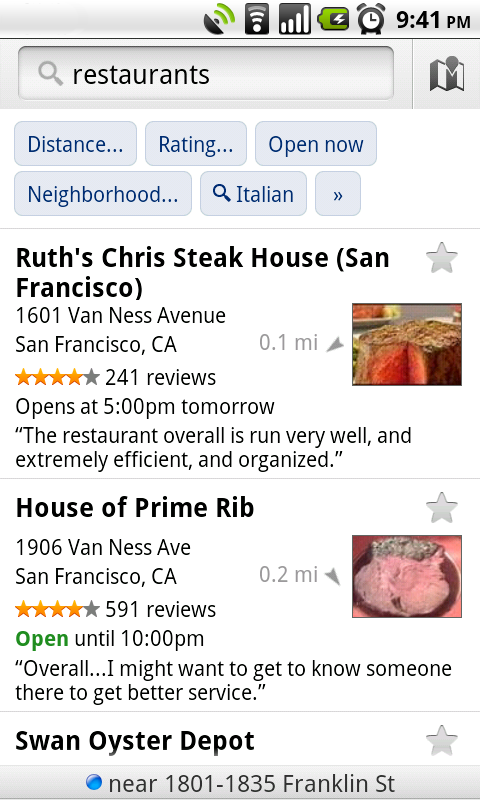
Find the right place with the updated reviews section (left) or search results filters (right).
In Latitude, you can also choose an experimental “Real-time updating” option from an individual Latitude friend’s profile page to help meet up with them by temporarily seeing faster location updates (friends must have Maps 4.6 and Android 2.2+).
Get Google Maps 4.6 for Android 1.6 and above everywhere Maps is already available. Just search for Google Maps in Android Market (or tap here from your phone).
Visit our Help Center to learn more or tell us your feedback and questions in our Help Forum.
Bring Your Phone to Work Day: Managing Android Devices With Google Apps
(Cross-posted and excerpted from the Official Google Enterprise Blog)
With over 200,000 devices activated each day, Android is seeing rapid adoption, and today we are launching new administrative controls that make it possible to securely manage these devices in the Google Apps environment. With this launch, Google Apps provides a comprehensive mobility solution for all major mobile platforms. You can manage most mobile devices right from the browser, without having to deploy dedicated servers.
 Many Android devices feature tight integration with Google Apps, including native applications for Gmail, Google Talk, and Google Calendar, as well as mobile access to Google Docs. Now any employee with an Android device running version 2.2 - personal or company-issued - can access their corporate information while allowing administrators to enforce data security policies such as:
These policies can be enforced on devices that have installed the Google Apps Device Policy application, which will be available from Android Market in the next few days. They will be available free to all Google Apps Premier and Education Edition customers in the next few days, and can be accessed from the 'Mobile' tab under 'Service Settings' in the Google Apps control panel.
To learn more about these updates in mobile device management for Google Apps, join us for a live webcast with Mayur Kamat, Google Apps Product Manager, on November 10, 2010 at 9 a.m. PDT / 12 p.m. EDT / 6 p.m. GMT. Register now
With over 200,000 devices activated each day, Android is seeing rapid adoption, and today we are launching new administrative controls that make it possible to securely manage these devices in the Google Apps environment. With this launch, Google Apps provides a comprehensive mobility solution for all major mobile platforms. You can manage most mobile devices right from the browser, without having to deploy dedicated servers.
 Many Android devices feature tight integration with Google Apps, including native applications for Gmail, Google Talk, and Google Calendar, as well as mobile access to Google Docs. Now any employee with an Android device running version 2.2 - personal or company-issued - can access their corporate information while allowing administrators to enforce data security policies such as:
- Remotely wipe all data from lost or stolen mobile devices
- Lock idle devices after a period of inactivity
- Require a device password on each phone
- Set minimum lengths for more secure passwords
- Require passwords to include letters and numbers
These policies can be enforced on devices that have installed the Google Apps Device Policy application, which will be available from Android Market in the next few days. They will be available free to all Google Apps Premier and Education Edition customers in the next few days, and can be accessed from the 'Mobile' tab under 'Service Settings' in the Google Apps control panel.
To learn more about these updates in mobile device management for Google Apps, join us for a live webcast with Mayur Kamat, Google Apps Product Manager, on November 10, 2010 at 9 a.m. PDT / 12 p.m. EDT / 6 p.m. GMT. Register now
Gmail in mobile Safari: now even more like a native app
Go to gmail.com from your iPhone and you’ll notice two improvements we’ve rolled out over the past few weeks. First, scrolling is snappier: the speed of scrolling reflects the speed of your swipe gesture. This is helpful for long conversations where a few quick flicks will get you to the information you need much faster than before. Second, the toolbars stay on screen while you’re scrolling rather than moving down into view after each scroll. Being able to access your toolbars from any point on the page should make it easier to triage your email and move around the app.

If you use Gmail in your mobile browser a lot, you may have noticed that we recently tried several different variations of these buttons. We‘ve iterated on the design and made improvements based on your feedback. If you have more suggestions, please post them in our forum, or if you use Twitter, mention #gmailmobile and we'll take a look. If you’re a developer and are interested in learning about the Javascript and HTML techniques we used to do this, we’ll post an article to code.google.com/mobile in the coming weeks.
You can see these improvements by visiting gmail.com from the browser of iPhone and iPod touch devices running iOS4 (English-only for now). And if you like Gmail in mobile Safari, make getting to it easier by tapping the “+” at the bottom of the screen and then “Add to Home Screen.” (Don’t see the new changes yet? Try clearing your cache and refreshing the page.)
Wireless Charging of Cell Phones Coming to Cars
Car makers are showing their interest in wireless charging as a General Motors executive is chairing a standards effort that hopes to set interoperability standards for the magnetic induction approach. Toyota and Ford said they also are interested in the technology and the standards effort.
The Consumer Electronics Association is trying to set a baseline for interoperability for chargers using magnetic coupling. One spec will target connections of less than 1 cm from coil to coil while another will address a 2-6 cm distance. The group will also try to define power efficiency and standard nomenclature for different technical approaches. The committee has said they will look at all the technologies that could provide wireless charging such as optical, RF and conductive as well as inductive approaches.
Smartphone apps for car functions and controls are a high priority for car makers now as the activity in this area has taken off quickly. Wireless charging is another point of integration and convenience to smartphone users. Although Toyota did not seem to think it is a high priority at this point, most car makers are working in this direction.
The Consumer Electronics Association is trying to set a baseline for interoperability for chargers using magnetic coupling. One spec will target connections of less than 1 cm from coil to coil while another will address a 2-6 cm distance. The group will also try to define power efficiency and standard nomenclature for different technical approaches. The committee has said they will look at all the technologies that could provide wireless charging such as optical, RF and conductive as well as inductive approaches.
Smartphone apps for car functions and controls are a high priority for car makers now as the activity in this area has taken off quickly. Wireless charging is another point of integration and convenience to smartphone users. Although Toyota did not seem to think it is a high priority at this point, most car makers are working in this direction.
A Tablet Could be Your Next Restaurant Menu
Tablets are quickly being adopted for many applications in business. I see real estate agents and contractors carrying them around to show clients information or take notes about a project. Now a new startup, E La Carte, is developing a new tablet-like computer for use in restaurants as a digital menu and ordering device. E La Carte is just one company trying to apply technology to help restaurants operate more efficiently and profitably while making customers happier. The company�s system is currently being tested at various Uno Chicago Grill locations.
E La Carte�s technology could help solve some restaurant frustrations and might get customers to spend a more. Customers can review the menu using a touchscreen tablet device and place their order when they are ready as the device is connected to the restaurant�s existing cash register system via Wi-Fi. There are also games and trivia to entertain you while waiting plus it offers functions such restaurant feedback, splitting the bill among several people, figuring out the tip, and paying via credit card. Being able to order and pay the bill when you are ready rather than waiting for the waiter/waitress to come by seems like a big advantage to the system and maybe you will order an extra beer since you can just press a button. Games and other entertainment applications can also keep kids occupied while waiting for the food.
There are other competing technologies that might come directly from the point of sale companies and probably more likely, just using your smartphone to perform the same function. Only time will tell which technology will work out. What do you think?
E La Carte�s technology could help solve some restaurant frustrations and might get customers to spend a more. Customers can review the menu using a touchscreen tablet device and place their order when they are ready as the device is connected to the restaurant�s existing cash register system via Wi-Fi. There are also games and trivia to entertain you while waiting plus it offers functions such restaurant feedback, splitting the bill among several people, figuring out the tip, and paying via credit card. Being able to order and pay the bill when you are ready rather than waiting for the waiter/waitress to come by seems like a big advantage to the system and maybe you will order an extra beer since you can just press a button. Games and other entertainment applications can also keep kids occupied while waiting for the food.
There are other competing technologies that might come directly from the point of sale companies and probably more likely, just using your smartphone to perform the same function. Only time will tell which technology will work out. What do you think?
Research Project: AppScale at University of California, Santa Barbara
The following post is a guest post by Chris Bunch, a Computer Science Ph.D. student at the University of California, Santa Barbara. He is one of the student leads on the AppScale project, an open source Google App Engine compatible hosting solution led by Professor Chandra Krintz. Chris has developed and maintained AppScale as a research project over the last two years with fellow student lead Navraj Chohan and others.
---------
Over here at the UCSB Racelab, we've complained endlessly about finding a web framework we actually could use. For a long time we thought we just wouldn't be able to find it - many were so-so or good but only after a substantial learning curve. So imagine our surprise back in April 2008 when we heard about what we thought would be just-another-web-framework provided by Google in the Python version of App Engine. But after giving it a try, we were smitten. We finally found a web framework that (1) we could actually use on non-trivial projects
and (2) we could teach in nine-week classes without having students lose half the time with the idiosyncrasies of the programming language involved or the web framework itself. Furthermore, the minimalistic APIs make it simple to get work done: it did for us exactly what we needed and nothing else.
Yet as researchers and hackers-at-heart there was one thing that we really wanted to do with App Engine that we couldn't do: run it on a whole bunch of our machines and tinker with it. A similarly-minded hacker named Chris Anderson had released AppDrop, which was a modified version of the App Engine SDK that hooked up to PostgresSQL and run in Amazon EC2, but only ran over a single machine. So after much discussion, we came up with the following short list of things we wanted to do with App Engine:
We wanted to run it on our own virtual machines or those running in Eucalyptus or Amazon EC2 in order to investigate how we can optimally harness cloud infrastructures in our cloud platform.
Tons of new datastores have emerged as part of the "NoSQL" movement, and we need a mechanism to evaluate their performance under controlled experiments as well as traditional databases such as MySQL. We also need a platform that supports the ability to add new data storage mechanisms so that when developers tout the features of their new datastore, we can download it and evaluate it under similar circumstances as other datastores.
One of the reasons we love Google App Engine is the simple set of APIs provided, but we also wanted to use that as a starting
point where we could add new APIs and control the environment in which they run.- We love that Google App Engine "just works". You don't know where it's running and how it's running, but you can see that it is running, and we wanted to make sure that whatever we developed, that it did the same. We wanted to develop something that automatically deployed your App Engine app and configured everything for you. Expert users should be able to have more control over the system, but the system should be able to handle your app from the moment you deploy it to the moment you tear it down.
It had to be open-source - just like how we wanted something to tinker with and run experiments on, we wanted it to be something that you could tinker with too. We wanted you to be able to add in support for a database you're interested in and see how it performs, and we wanted you to be able to add in APIs that you think would be interesting to have an easy-to-use web framework interact with.
So with that in mind, we created AppScale, an open-source cloud platform
for Google App Engine applications. Here's how we did it:
We took the standard three-tier web deployment approach and clearly segmented each tier into a specific component in the system: an AppLoadBalancer routes users to their applications, an AppServer runs the user's App Engine app, and an AppDB handles database interactions. Each have clearly defined roles in the system and are controlled by an AppController, a daemon that runs on each machine, monitors each component, and controls the specific order in which services are started. It writes all the configuration files for each service and coordinates services between the other AppControllers in the deployment. For those interested, we detail the specifics on the original AppScale implementation in this paper.
We also wanted to embody the principle of "standing on the shoulders of giants", and as such, we employ open-source software as often as possible, where appropriate. Our AppLoadBalancer employs the nginx web server as well as the haproxy load balancer to ensure high performance. Our Memcache API implementation uses memcache under the hood, while our MapReduce API uses Apache Hadoop, which we added to give App Engine
users running over AppScale the ability to run Hadoop MapReduce jobs from within their web applications.
Because we were able to keep the database support abstracted away from the other components in the system, we were able to add support for nine different data storage solutions within AppScale: HBase, Hypertable,
MySQL, Cassandra, Voldemort, MongoDB, MemcacheDB, Scalaris, and SimpleDB. Many of these databases have seen interest in recent years but have been hard to measure under comparable conditions, and vary greatly. To give a few examples, they vary in the query languages they provide, their topologies (e.g., master / slave, peer-to-peer), data consistency policies, and end-user library interfaces. This has made it non-trivial for the community to objectively determine scenarios in which one database performs better or worse than another and investigate why, but under AppScale, deploying all these databases is done automatically with no interaction from the user. And because AppScale is open-source, if a developer doesn't like the particular interface we use for a database, they can improve on it and give back to the community. We've used
AppScale internally to evaluate the performance of Google App Engine applications on these datastores as well as developed an App Engine app, Active Cloud DB, that exposes a RESTful API that developers can use
to access these datastores from any programming language or web framework.
Finally, the most important lesson we learned was the value of incremental development. Our core development team fluctuates between two to three developers, so from the first meeting we had, we knew that
our very first release couldn't support every App Engine API nor could it run nine databases seamlessly. Therefore, we started off with support for the two BigTable clones, HBase and Hypertable, as well as support
for just the Datastore API, the URL Fetch API, and the Users API within App Engine. From there, we learned what datastores people actually wanted to see support for as well as what APIs people wanted to use. We
were also able to add APIs within App Engine apps deployed to AppScale to be able to run virtual machines under the EC2 API, while also running computation under the MapReduce API.
But developing AppScale was certainly not a cakewalk for us. Over the course of the last two years, five major issues (some technical and some not) have arisen within the project:
Writing software that works without knowing ahead of time how many machines will be in the system proved initially to be difficult to grasp, but in many cases we were able to reduce the number of variations that could occur and use that to provide some predictability with respect to how we configure and deploy databases and applications.
We couldn't assume that the AppScale administrator has access to DNS; without it, a number of APIs and features are extremely difficult to implement. Load balancing is much more difficult, and many APIs that are tied to host names must be tied to one machine in the system, else they don't work properly. VLAN tagging shows some promise to alleviate these problems, but right now is far from being deployed inexpensively and easily.
The source code for the Java version of App Engine isn't publicly available, so we had to spend a lot of time decompiling the SDK, modifying it to use our database and our API implementations instead of the SDK implementations, and recompiling it. All of these were non-trivial and greatly added to the time it took for us to deploy a version of AppScale with Java App Engine support.
Not all users want a pre-built virtual machine image, so ensuring that building the AppScale environment was done right every time was a top priority. We had to limit ourselves to Ubuntu Jaunty for many releases, and only recently were we able to expand to include Karmic and Lucid, which still make up a microcosm of the distributions available in the Linux world. Adding the ability to install AppScale via apt-get in these specific Linux distributions has also been a crucial step in making sure that users could easily and quickly install AppScale for use.
Both undergraduates and graduate students here at UCSB have done projects involving AppScale, which means that the number and experience levels of developers working on AppScale is completely unpredictable at a given moment in time. Oftentimes the projects they work on are only tangentially related to features that users want, and the time scales that they are available to work for is vastly different than most software engineers are used to.
All of these problems are greatly exacerbated by only having a two-to-three person core developer team, but this also makes the AppScale project particularly interesting to work on. Despite having worked on AppScale for two years, there are still tons of interesting problems to work on and we still love the Python App Engine web framework as much as we did when we first picked it up. And of course, AppScale is open-source, under the New BSD License, so feel free to download it and tinker around like we have! Check out AppScale at:
http://code.google.com/p/appscale
-- Chris
Voice Search in Russian, Polish, Czech and Turkish
Over the past few weeks we have launched Voice Search in four new languages: Russian, Polish, Czech and Turkish. Try speaking queries like “концерты Юлии Савичевой” (tour dates for Yulia Savicheva), “przepis na pierogi” (recipes for pierogi), “obrázky Hradčan” (pictures of the Prague castle), or “istanbul hava durumu” (weather in Istanbul). Note that you can only speak one language into the app at any time and that you’ll need to change your language setting first.


Voice Search is often preloaded on new Android devices. In that case, all you have to do is press and hold the search button and then speak your query. If you have an Android (2.0 or higher) phone but don’t have Voice Search installed, download the “Voice Search” app from Android Market. If you own an iPhone or other smartphone, you can download Google Mobile App with Voice Search from m.google.com
A Look at Antenna Tower Field Repair

If you think working in an office or a lab is tough, imagine repairing equipment on top of an antenna tower at over 1,700 feet. This video is making its way around facebook and is certainly not for people who are afraid of heights. As impressive as the hardware is, operating outdoors under extreme environmental conditions, I must express equal respect for the linemen who service these towers.
Test and measurement vendors have been producing a number of handheld instruments designed to make their jobs easier and safer. I just can't imagine operating a VNA or spectrum analyzer from that height when all I'd want to do is hang on for dear life.
Watch Video>>
Google on Pace to Top $1 billon in Mobile Revenue
Google�s increasing focus on mobile was addressed in its financial results announcement last night. Google said it is seeing very strong growth in emerging businesses like mobile, with Jonathan Rosenberg, senior VP of product management, noting that Google is on pace to generate more than $1 billion in annual mobile search and display revenue. Rosenburg cited an interesting example of mobile ads that are working well, telling analysts on a conference call to do a search for �car rental� on their phones. There's a "very good chance you'll see enterprise rental car ad," with a phone number and map to the nearest location, he commented.
CEO Eric Schmidt outlined Google�s objectives with Android. In response to Wall Street analysts asking about whether Google is making money as it just gives away the operating systems to handsets makers, Schmidt said that this strategy is Google's preferred model. Handset makers and operators are going to make money from selling the phones, while Google will generate cash from having its services on that platform. Rosenburg said that mobile search queries have increased 500 percent over the past two years, Schmidt added that the money in mobile search is eventually going to surpass that on PCs, creating a huge revenue stream.
Wow, we are really going mobile these days and Google will be where ever we are! Microsoft is trying but do you think any company can give Google a run for their money in search?
CEO Eric Schmidt outlined Google�s objectives with Android. In response to Wall Street analysts asking about whether Google is making money as it just gives away the operating systems to handsets makers, Schmidt said that this strategy is Google's preferred model. Handset makers and operators are going to make money from selling the phones, while Google will generate cash from having its services on that platform. Rosenburg said that mobile search queries have increased 500 percent over the past two years, Schmidt added that the money in mobile search is eventually going to surpass that on PCs, creating a huge revenue stream.
Wow, we are really going mobile these days and Google will be where ever we are! Microsoft is trying but do you think any company can give Google a run for their money in search?
New App Engine SDK 1.3.8 includes New Admin Tools and Performance Improvements
Today, we’re releasing version 1.3.8 of the App Engine SDK. Whether you’re a Java or a Python developer, this release includes several exciting new features for improving monitoring, performance, and maintenance tasks.
Instances Console
This release includes a new page in the Admin Console, called the Instances page. This page allows you to view information about all server instances currently in use by your application. This information can be useful in debugging your application and also understanding its performance characteristics. There’s no configuration needed for this feature. Just click the “Instances” link on the left hand navigation of the Admin Console to see Average QPS, latency, and memory for an instance.

Screenshot of the instances page of the Admin Console
Task Queue Improvements
This release also has a couple new Task Queue features: First, the maximum bucket size that you can specify during queue configuration is now 100, up from 50. Second, we’ve added a new "Run Now" button to the Task Queues section of the Admin Console that enables developers to run a task immediately. This can be very helpful for debugging your tasks in production.
Builtins Directives
This release contains a new feature for Python apps: builtin handlers that allow you to quickly and easily enable standard functionality in your application without adding additional code to your codebase. The libraries available today are remote_api, appstats, and the datastore_admin feature (see below). For example, to use the remote_api with your application, simply add the following to your app.yaml file:
builtins:
- remote_api: on
If you are already using the remote api endpoint your app, you can choose to remove the entry in the handlers section of your app.yaml and use the above directive instead to simplify your app.yaml file.
Support for builtin handlers is not yet available for Java applications, but will be available in an upcoming release.
Delete all (or a part) of your application’s data
Note: this feature is currently only available by default for Python; see the note below for ways to use it with Java application.
Today, we are releasing an experimental addition to the admin console which provides a simple UI for delete all entities, or all entities of a given kind, in your datastore. To enable this functionality, simply enable the following builtin in your app.yaml file:
builtins:
- datastore_admin: on
Adding these lines to app.yaml enables the “Datastore Admin” page in your app’s Admin Console, where you can see all of the entity types you are able to delete:

Screenshot of the datastore delete builtin UI
Be aware that these deletes are issued by your application (you can read about how the handler works by looking at this code file in the SDK). For this reason, your application will use resources, most significantly CPU, for the deletions you issue which will count towards your application’s daily resource budget.
Datastore delete is currently available only with the Python runtime. Java applications, however, can still take advantage of this feature by creating a non-default Python application version that enables Datastore Admin in the app.yaml. Native support for Java will be included in an upcoming release.
Python Pre-compilation on by Default
Finally, the python pre-compilation feature we announced in 1.3.5 is now turned on for all new python application uploads using the 1.3.8 SDK by default. If you wish to disable this feature, just specify the flag --no-precompilation on the appcfg.py command line when uploading your app.
This release also contains a few more small features and bug fixes. You can read about the full release in our release notes in Python and Java. As always, your feedback in the forums is appreciated (and had a significant influence on this release!).
Addressing Smartphone Interference with your Alarm Clock
It happens in my house late and night or early in the morning, when I forget to turn off my Blackberry and the stream of incoming e-mail spams lead to pick-up with the audio portion of my clock radio, setting off an annoying buzz. It is highly likely that most of us have been in meetings, on conference calls or even watching television and have been victims of �the buzz� - that awful annoying feedback emitted from mobile devices when they are in close proximity to audio devices.
That annoying buzz occurs when an electrical audio device amplifies a cell phone radio signal. The buzzing problem is so common because 80 percent of the world's cell phones rely on GSM (Global System for Mobile communications) technology. GSM phones transmit at a pulse rate that, when picked up and converted by a speaker in an audio device, is transmitted as audio noise � that annoying buzz.
The Buzz Killer Card, a new, easy-to-use cell phone accessory that eliminates buzzing interference that audio devices � such as conference call speakerphones, desktop lines, desktop speakers, baby monitors, and clock radios � pick up (and buzz!) when a mobile device is nearby.The Card, which is slightly larger than a standard cell phone, is designed with a proprietary, patent-pending alloy technology that neutralizes cell phone radio interference.
"Driven absolutely crazy alongside millions of other cell phone owners, we were determined to find a solution � once and for all � to the buzz problem," said Stephen Mellert, Chief Executive Officer of The Buzz Killers. "We conducted months and months of in-depth research on cell phone transmission frequencies and a range of trials, and errors, on various materials until we arrived at the perfect solution."
The Buzz Killer Card users simply need to place their cell phone on the Card to eliminate the interference. Like a mouse-pad for your phone, the Buzz Killer Card can be used virtually anywhere including meeting rooms with conference phones, offices and cubicles, trading desks, home offices, cars, audio studios, baby nurseries, etc.
The Buzz Killer Card manufacturers claim that businesses have found that the Buzz Killer Card's customizable design provides a perfect platform for customer-directed corporate marketing and branding, making it an ideal corporate give-away for conference events and exhibitions. Businesses using the Buzz Killer Card, have described it as an ideal marketing tool that provides a great "ice breaker" moment that creates a bond between presenter and recipient.
That annoying buzz occurs when an electrical audio device amplifies a cell phone radio signal. The buzzing problem is so common because 80 percent of the world's cell phones rely on GSM (Global System for Mobile communications) technology. GSM phones transmit at a pulse rate that, when picked up and converted by a speaker in an audio device, is transmitted as audio noise � that annoying buzz.
The Buzz Killer Card, a new, easy-to-use cell phone accessory that eliminates buzzing interference that audio devices � such as conference call speakerphones, desktop lines, desktop speakers, baby monitors, and clock radios � pick up (and buzz!) when a mobile device is nearby.The Card, which is slightly larger than a standard cell phone, is designed with a proprietary, patent-pending alloy technology that neutralizes cell phone radio interference.
"Driven absolutely crazy alongside millions of other cell phone owners, we were determined to find a solution � once and for all � to the buzz problem," said Stephen Mellert, Chief Executive Officer of The Buzz Killers. "We conducted months and months of in-depth research on cell phone transmission frequencies and a range of trials, and errors, on various materials until we arrived at the perfect solution."
The Buzz Killer Card users simply need to place their cell phone on the Card to eliminate the interference. Like a mouse-pad for your phone, the Buzz Killer Card can be used virtually anywhere including meeting rooms with conference phones, offices and cubicles, trading desks, home offices, cars, audio studios, baby nurseries, etc.
The Buzz Killer Card manufacturers claim that businesses have found that the Buzz Killer Card's customizable design provides a perfect platform for customer-directed corporate marketing and branding, making it an ideal corporate give-away for conference events and exhibitions. Businesses using the Buzz Killer Card, have described it as an ideal marketing tool that provides a great "ice breaker" moment that creates a bond between presenter and recipient.
An easier way to use Google Latitude on your computer
We’re happy to introduce an easier way to use Google Latitude from your computer at google.com/latitude. You can now see where your friends are, start using Latitude apps, and share your location all from one place when you’re at your computer.
Find your friends
We launched Latitude with a desktop iGoogle gadget to help you stay in touch with friends and family that may not have a smartphone. We’ve since learned that a desktop experience is important to you even if you’re already using Latitude on your phone. Today, you can now visit a dedicated site that makes it easier than ever to use Latitude when you’re already on your computer. From the Friends tab, you can:
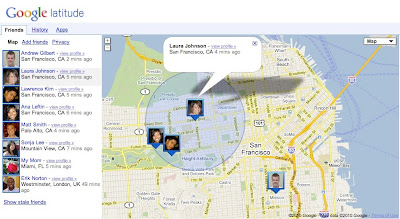
Do more with Latitude
You’ll also now find Latitude and Latitude apps together in one place. After browsing your friends list, go to the History or Apps tabs to turn on optional Latitude apps such as:
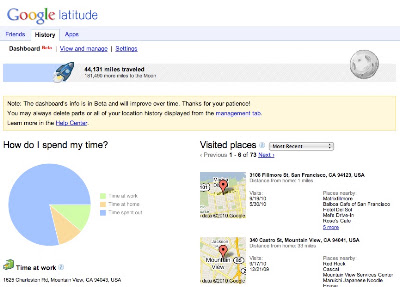
Share your location
Just like on your phone, you can choose to share your location with friends and family from your WiFi-enabled computer. Before you can share your location, you’ll need to first give Latitude permission to access your location when prompted by your supported browser. You can always change your browser or Latitude privacy settings later. Learn more in the Help Center.
To get started, go to google.com/latitude on your computer. If you’re new to Latitude, you can then start on your phone by sending yourself a text message or choose to start on your computer.
Find your friends
We launched Latitude with a desktop iGoogle gadget to help you stay in touch with friends and family that may not have a smartphone. We’ve since learned that a desktop experience is important to you even if you’re already using Latitude on your phone. Today, you can now visit a dedicated site that makes it easier than ever to use Latitude when you’re already on your computer. From the Friends tab, you can:
- See where your friends are on Google Maps
- Add friends and accept sharing requests
- Control your privacy settings

Do more with Latitude
You’ll also now find Latitude and Latitude apps together in one place. After browsing your friends list, go to the History or Apps tabs to turn on optional Latitude apps such as:
- Google Location History (Beta) to see your personal history dashboard
- Google Location Alerts to get nearby friend alerts
- Google Talk Location Status to post your location in your chat status
- Google Public Location Badge to publish your location on your blog or site

Share your location
Just like on your phone, you can choose to share your location with friends and family from your WiFi-enabled computer. Before you can share your location, you’ll need to first give Latitude permission to access your location when prompted by your supported browser. You can always change your browser or Latitude privacy settings later. Learn more in the Help Center.
To get started, go to google.com/latitude on your computer. If you’re new to Latitude, you can then start on your phone by sending yourself a text message or choose to start on your computer.
Open your eyes: Google Goggles now available on iPhone in Google Mobile App
Searching with Google on your mobile phone can be an eye-opening experience. Now your phone’s camera can even help to find out more about the world around you.
Back in December we introduced Google Goggles on Android: it lets you search by taking pictures. Today, we’re excited to announce that Goggles is now a feature of Google Mobile App for iPhone. Google Mobile App already lets you speak your queries, and it can also use your phone’s location to give you more relevant search results.


In the new version of Google Mobile App just tap on the camera button to search using Goggles. Goggles will analyze the image and highlight the objects it recognizes -- just click on them to find out more. You can see how this works in this short video:
Computer vision is a hard problem and Google Goggles is still a Labs product. It works well for things such as landmarks, logos and the covers of books, DVDs and games. However, it doesn’t yet work for some things you might want to try like animals, plants or food.
Google Mobile App with Google Goggles is now available in the Apple App Store. Just search for “Google Mobile App” and download the latest version - it’s free. It will gradually be appearing in all App Stores around the world starting from today.
Goggles is enabled only for English-speaking users, and since it requires an auto-focusing camera it is supported only on iPhone 3GS and iPhone 4 running iOS 4 or above. Visit our Help Center to learn more or send us your feedback and questions in our Help Forum.
So step away from your computer, get your Goggles on, and search the world around you.
Back in December we introduced Google Goggles on Android: it lets you search by taking pictures. Today, we’re excited to announce that Goggles is now a feature of Google Mobile App for iPhone. Google Mobile App already lets you speak your queries, and it can also use your phone’s location to give you more relevant search results.


In the new version of Google Mobile App just tap on the camera button to search using Goggles. Goggles will analyze the image and highlight the objects it recognizes -- just click on them to find out more. You can see how this works in this short video:
Computer vision is a hard problem and Google Goggles is still a Labs product. It works well for things such as landmarks, logos and the covers of books, DVDs and games. However, it doesn’t yet work for some things you might want to try like animals, plants or food.
Google Mobile App with Google Goggles is now available in the Apple App Store. Just search for “Google Mobile App” and download the latest version - it’s free. It will gradually be appearing in all App Stores around the world starting from today.
Goggles is enabled only for English-speaking users, and since it requires an auto-focusing camera it is supported only on iPhone 3GS and iPhone 4 running iOS 4 or above. Visit our Help Center to learn more or send us your feedback and questions in our Help Forum.
So step away from your computer, get your Goggles on, and search the world around you.
EuMW Exhibition 2010: from A to Z
A is for agnostic nonlinear model support, the leading news from AWR in support of the Cardiff models, the latest S-functions from NMDG and X-parameters from Agilent
B is for broadband time delays product line from Hittite, a DC to 24 GHz analog time delay that supports data transmission to 32 Gbps or clock signal delay up to 24 GHz.
C is for cross correlation Phase Noise analyzers from Holzworth for either fixed or tunable DUT test frequencies.
D is for distortion, an increasing concern highlighted by the importance of IM levels and a driving factor behind Creowave�s announcement that they have developed low PIM filtering solutions to measure the performance of base stations.
E is for EADS Defence & Security making the name change to Cassidian, just in time for their presentation at the Defence/Security Executive Forum
F is for FE-BI (finite element boundary integral) hybrid solver from Ansoft, details to follow in the months to come.
G is for GaN which made an appearance with numerous vendors from RFHIC (1 KW PA) to ACCEL-RF (GaN life test systems)
H is for High purity alumina ceramics with excellent electrical insulation, chemical resistance and low dielectric constant introduced by Brush Ceramic Products, Inc.
I is for ICEbreaker, the newest nonlinear device modeling software tool, free from NMDG
J is for jitter analysis, made easier by the new �C� series of Tektronix AWG instruments which reduce waveform creation times by 45 percent compared to prior AWG instruments, targeting high-speed serial and wideband RF/microwave designs.
K is for K-band MMIC design, getting a boost with the new optical .15 um PHEMT process from TriQuint�s foundry.
L is for Liquid Crystal Polymer (LCP) QFN, air cavity packages that support finer lead pitches, thinner lead frames and shorter wire bond lengths in a near hermetic, ROHS-compliant solution from RJR Polymers
M is for mixed-signal active load-pull from Anteverta, featured in our September issue and on display at their stand within the Agilent partners� pavilion
N is for NEL Frequency Controls Inc.�s latest ultra low phase noise OCXO at 100 MHz with close-in phase noise of -105 dBc/Hz at 10 Hz and -178 dBc/Hz phase noise on the floor.
O is for output powers of 600 W UHF RF power from NXP�s BLF888A LDMOS device targeting broadcast transmitters and industrial applications, reported to be the most powerful LDMOS broadcast transistor in the market to date.
P is for Precision Devices which announced an ultra low noise and ultra stable crystal oscillator with a phase noise floor of -168 dBc at 10 kHz and excellent stability at a precision of only 0.0002 ppm (or 0.2 ppb � parts per billion) over a temperature range of 0 to +70�C or 0.0005 ppm at -20� to +70�C.
Q is for quality factor, a critical measure of passive device electrical performance and a differentiator for Dielectric Labs� High-Q capacitor series.
R is for the Russian microwave market, represented by Pluton, manufacturers of frequency-agile magnetrons.
S is for small, as in the industry�s first PXI VNA from National Instruments
T is for the TWT based on a mini-helix technology being launched by e2v
U is for universal oscilloscopes from Rohde & Schwarz with 500 MHz bandwidth, 5 Gsample per second and a memory depth of up to 8 Msample make them ideal for testing and debugging analog and digital circuits with low clock rates.
V is for Vector signal analysis software from Agilent to assist R&D engineers performing signal and modulation analysis
W is for Wall, as in A.T. Wall, manufacturer of seamless tubing and high-speed stamping and proud sponsor of the Defense/Security Executive Forum at EuMW
X is for X-band core chips from M/A-Com Tech Asia, highly-integrated core chips that provide high-levels of functionality to greatly simplify the design of T/R modules.
Y is for yield analysis in Microwave Studio from CST is based on evaluating the s-parameter dependencies on various model parameters on the basis of one simulation without restarting the full-wave simulation, thus offering users a considerable speed-up.
Z is for Z-Communications, manufacturers of VCOs and PLLs announced a new line of waveguide solutions including full-band waveguide-to-coax-adapters along with precision, low powered waveguide terminations covering 5 GHz to 40 GHz.
B is for broadband time delays product line from Hittite, a DC to 24 GHz analog time delay that supports data transmission to 32 Gbps or clock signal delay up to 24 GHz.
C is for cross correlation Phase Noise analyzers from Holzworth for either fixed or tunable DUT test frequencies.
D is for distortion, an increasing concern highlighted by the importance of IM levels and a driving factor behind Creowave�s announcement that they have developed low PIM filtering solutions to measure the performance of base stations.
E is for EADS Defence & Security making the name change to Cassidian, just in time for their presentation at the Defence/Security Executive Forum
F is for FE-BI (finite element boundary integral) hybrid solver from Ansoft, details to follow in the months to come.
G is for GaN which made an appearance with numerous vendors from RFHIC (1 KW PA) to ACCEL-RF (GaN life test systems)
H is for High purity alumina ceramics with excellent electrical insulation, chemical resistance and low dielectric constant introduced by Brush Ceramic Products, Inc.
I is for ICEbreaker, the newest nonlinear device modeling software tool, free from NMDG
J is for jitter analysis, made easier by the new �C� series of Tektronix AWG instruments which reduce waveform creation times by 45 percent compared to prior AWG instruments, targeting high-speed serial and wideband RF/microwave designs.
K is for K-band MMIC design, getting a boost with the new optical .15 um PHEMT process from TriQuint�s foundry.
L is for Liquid Crystal Polymer (LCP) QFN, air cavity packages that support finer lead pitches, thinner lead frames and shorter wire bond lengths in a near hermetic, ROHS-compliant solution from RJR Polymers
M is for mixed-signal active load-pull from Anteverta, featured in our September issue and on display at their stand within the Agilent partners� pavilion
N is for NEL Frequency Controls Inc.�s latest ultra low phase noise OCXO at 100 MHz with close-in phase noise of -105 dBc/Hz at 10 Hz and -178 dBc/Hz phase noise on the floor.
O is for output powers of 600 W UHF RF power from NXP�s BLF888A LDMOS device targeting broadcast transmitters and industrial applications, reported to be the most powerful LDMOS broadcast transistor in the market to date.
P is for Precision Devices which announced an ultra low noise and ultra stable crystal oscillator with a phase noise floor of -168 dBc at 10 kHz and excellent stability at a precision of only 0.0002 ppm (or 0.2 ppb � parts per billion) over a temperature range of 0 to +70�C or 0.0005 ppm at -20� to +70�C.
Q is for quality factor, a critical measure of passive device electrical performance and a differentiator for Dielectric Labs� High-Q capacitor series.
R is for the Russian microwave market, represented by Pluton, manufacturers of frequency-agile magnetrons.
S is for small, as in the industry�s first PXI VNA from National Instruments
T is for the TWT based on a mini-helix technology being launched by e2v
U is for universal oscilloscopes from Rohde & Schwarz with 500 MHz bandwidth, 5 Gsample per second and a memory depth of up to 8 Msample make them ideal for testing and debugging analog and digital circuits with low clock rates.
V is for Vector signal analysis software from Agilent to assist R&D engineers performing signal and modulation analysis
W is for Wall, as in A.T. Wall, manufacturer of seamless tubing and high-speed stamping and proud sponsor of the Defense/Security Executive Forum at EuMW
X is for X-band core chips from M/A-Com Tech Asia, highly-integrated core chips that provide high-levels of functionality to greatly simplify the design of T/R modules.
Y is for yield analysis in Microwave Studio from CST is based on evaluating the s-parameter dependencies on various model parameters on the basis of one simulation without restarting the full-wave simulation, thus offering users a considerable speed-up.
Z is for Z-Communications, manufacturers of VCOs and PLLs announced a new line of waveguide solutions including full-band waveguide-to-coax-adapters along with precision, low powered waveguide terminations covering 5 GHz to 40 GHz.
EuMW 2010 Exhibition Report: The lay of the land
European Microwave Week was held in the CNIT convention center in the newer business center that lies to the west of the city�s center, a straight shot down Rue Charles de Galle, about three and a half miles from the Arc de Triomphe. The Center of New Industries and Technologies, or CNIT, is one of the first buildings to ever be constructed in La D�fense, Paris. It is a palace for the French Congress that houses the main offices and also functions as a convenience store for the congressmen and their visitors. The initial construction of CNIT was completed in 1958 and the conference and exhibition center provides a unique and interactive place for people to meet and exchange information.

CNIT Paris is the biggest conference and exhibition center in Europe, containing more than 3 Amphitheatres, 21 adaptable rooms, and has over 17,000 square meters of exhibition area. The exhibition, which opened Tuesday, was in the lower regions of the convention center and the relatively low ceiling either gave the show an intimate or claustrophobic feel, depending on one�s perspective.
The staff at National Instruments proudly show off their new PXIe-1082 which can be configured into a small but fast (400usec/pt) multi-channel VNA (10 MHz to 6 GHz), targeting autotest applications.
The CNIT is in the plaza at La Defense, which is also home to the Grande Arche - a modern take on the Arc de Triomphe.
CNIT Paris is the biggest conference and exhibition center in Europe, containing more than 3 Amphitheatres, 21 adaptable rooms, and has over 17,000 square meters of exhibition area. The exhibition, which opened Tuesday, was in the lower regions of the convention center and the relatively low ceiling either gave the show an intimate or claustrophobic feel, depending on one�s perspective.
Without the usual signs draped from the ceiling above the larger exhibition booths, attendees were forced to navigate the space at the floor level, changing the scale of the entire show - for better or worse. Finding certain exhibitors may have been harder in some cases, but the layout may also have helped force attendees to be more aware of their surroundings and discover vendors they might otherwise have breezed by.
The entrance to the exhibition space was dominated by test and measurement equipment vendors � Agilent, Rohde & Schwarz and Anritsu. Agilent commanded the front of the exhibition hall with an impressive stand filled with no less than eight demo stations, meeting room and a half dozen additional demo stations for partnering companies including Maury Microwave, AMCAD, Anteverta Microwave and SATIMO.
Adjacent to Agilent was the European T&M home team of Rohde & Schwarz, also displaying the latest in their test solutions. Stage left of R&S was Anritsu, a manufacturer which has had a flurry of new product releases over the past several months, much of which was on display for the first time at EumW. Anyone shopping for test equipment could easily spend their time in this one area of the trade show.


Greeting visitors beyond the test and measurement equipment were the majority of software vendors CST, AWR, Ansys (Anosft), Mician, Sonnet, National Instruments and MIG to name a few. Slightly deeper into the heart of the exhibition floor, the types of vendors quickly diversified to the Integrated Device Manufacturers (TriQuint, M/A-Com, Analog Devices, Hittite, NXP and Mitsubishi), passive components, cable, connector manufacturers and material suppliers. One could also find other peripheral test products from VTD, NMDG and Tektronix/Mesuro�s non-linear characterization test equipment and software to turn-key life test solutions from Accel-RF. The complete list of vendors is available on the European Microwave Week web site (http://www.eumweek.com/2010/MapYourShow.asp) and Richard Mumford, our international editor and I will be posting our reports on meeting with various vendors over the next week.
While the floor traffic was not exceptionally crowded, it was respectable and constant. In conversations with exhibitors, most were happy with the quality of people they met at the show and many of them were either closing deals or making worthy new contacts. While many exhibitors were not introducing new products explicitly for this event, many had new products that had never been seen by this show�s attendees. Combined with a �better than last year� economic outlook, most exhibitors were poised for growth� and even vocal about it. That is certainly a 180 degree turn around from 2008, when the crisis had just hit and no one knew what the future had in store.
While the floor traffic was not exceptionally crowded, it was respectable and constant. In conversations with exhibitors, most were happy with the quality of people they met at the show and many of them were either closing deals or making worthy new contacts. While many exhibitors were not introducing new products explicitly for this event, many had new products that had never been seen by this show�s attendees. Combined with a �better than last year� economic outlook, most exhibitors were poised for growth� and even vocal about it. That is certainly a 180 degree turn around from 2008, when the crisis had just hit and no one knew what the future had in store.


SV Microwave shows off its connector wares to a fellow exhibitor
With the conferences on a separate floor, it was not immediately apparent how many delegates managed to get over to the exhibition. The conference organizers did promote the exhibition to delegates during the plenary session and with few complaints from exhibitors, I am assuming most ventured into the exhibition at some point during the week. To summarize, the general feel of the show, it was upbeat if not giddy and the majority of vendors will likely go to next years' show in Manchester UK. All in all, I would say this year's event "got the intended job done".

Tom Arthur of Valpey Fisher poises for the press alongside a EumW delegate.
Car Home for Android Gets Personal
Car Home for Android turns your Android phone into a better driving companion by providing you with quick access to key applications on the go: GPS navigation, voice-activated commands, contacts, and more. Today, we’re releasing a new version of Car Home for Android (Update: currently for Nexus One and Motorola Droid, only) which makes it easier to customize Car Home to get the information you need faster.


You can launch Car Home by opening the app directly from your phone or docking your phone in a car dock, and now you can automatically switch to Car Home when your phone pairs with any Bluetooth™ device. Simply select “Settings” from the Car Home screen and select which of your paired Bluetooth™ devices you want to automatically trigger Car Home.
Want to customize Car Home even more? You can now set your own wallpaper for Car Home. Just select “Settings” in Car Home and choose a wallpaper that fits your tastes. You can also customize the color of the shortcut icons to really make the Car Home experience your own.

We’ve also made it simpler for Android developers to modify their existing applications to be compatible with Car Mode. Apps which support Car Mode will show up in a “Car applications” category so they can easily be identified by you and added as a shortcut.
The new version of Car Home for Android is available for Android 2.2. You can get the update from Android Market by searching for “Car Home” in Android Market or tap here on your Android device.
Don’t forget, while your Android-powered companion can assist you while you drive, please keep your eyes on the road and drive safely at all times!
The new version of Car Home for Android is available for Android 2.2. You can get the update from Android Market by searching for “Car Home” in Android Market or tap here on your Android device.
Don’t forget, while your Android-powered companion can assist you while you drive, please keep your eyes on the road and drive safely at all times!
Update 10/1/10 10:28 PST: The new Car Home is available for Nexus One and Motorola Droid. Visit our Help Center to learn more or send us your feedback and questions in our Help Forum.
Posted by Markus Mühlbauer, Manager Engineering & Product, Google Automotive
Posted by Markus Mühlbauer, Manager Engineering & Product, Google Automotive
App Engine conference appearances this Fall
It's conference season, and we're going around the world again! This fall, Google team members will be speaking about App Engine at events in more than 10 countries! In addition to the regular conference circuit, Google is also hosting Developer Days and DevFests in a variety of locations to bring not only App Engine but a bunch of Google technologies directly to you!
Fall 2010:
- Sep 30 - Oct 1 - OpenWorld Forum - Paris - Patrick Chanezon
- Oct 1 - Google DevFest Taiwan - Taipei - Ping Yeh
- Oct 2-4 - Cloud3Days - Fukuoka (JP) - Takashi Matsuo
- Oct 9-10 - Silicon Valley CodeCamp - Los Altos Hills (US) - Wesley Chun, Chris Schalk
- Oct 18-22 - Interop - New York - Sean Lynch
- Oct 19-22 - SpringOne 2GX - Chicago - Chris Schalk
- Oct 26-27 - PayPal X Innovate - San Francisco - Chris Schalk, Ikai Lan
- Oct 27-28 - GOSCON10 - Portland - Wesley Chun
- Oct 29 - Google Developer Day Brazil - São Paulo - Patrick Chanezon
- Oct 29-30 - Google DevFest Nigeria - Lagos - Richard Ngamita
- Nov 1-4 - Cloud Computing Expo (West) - Santa Clara - Chris Schalk
- Nov 2 - Google DevFest Argentina - Buenos Aires - Patrick Chanezon
- Nov 8-9 - Google G|South Africa - Cape Town - Richard Ngamita
- Nov 9 - Google Developer Day Germany - Munich - Fred Sauer, Patrick Chanezon, Simon Meacham
- Nov 9-11 - Management World Americas (Cloud Summit) - Orlando - Wesley Chun
- Nov 12 - Google Developer Day Russia - Moscow - Fred Sauer, Patrick Chanezon, Mike Aizatsky, Simon Meacham
- Nov 16 - Google Developer Day Czech Republic - Prague - Fred Sauer, Patrick Chanezon, Simon Meacham
- Nov 16-17 - Cloud Security Alliance Congress - Orlando - Wesley Chun
- Dec 8-9 - LeWeb - Paris - Patrick Chanezon, Simon Meacham
We look forward to meeting you at one (or more) of these events!
Posted by Wesley Chun, Google App Engine team
Explore seven continents with Street View on your phone
Head over to the Official Google Blog to read more about Street View on seven continents.
Two years ago, we added Street View to Google Maps for mobile so you could explore the world at street level right from your phone. Today, we’re happy to announce that you can see Street View imagery on all seven continents, with the addition of Brazil, Ireland and Antarctica – specifically, an area called Half Moon Island. Now, you can really explore the world from the palm of your hand.
We encourage you to go ahead and check out the beaches of Brazil, visit the moors of Ireland or see penguins in Antarctica for yourself.


To use Street View on Google Maps for your supported phone, select a place on the map and then choose the Street View option if available. With an Android-powered phone, try hopping across each continent with the new Street View smart navigation.
Two years ago, we added Street View to Google Maps for mobile so you could explore the world at street level right from your phone. Today, we’re happy to announce that you can see Street View imagery on all seven continents, with the addition of Brazil, Ireland and Antarctica – specifically, an area called Half Moon Island. Now, you can really explore the world from the palm of your hand.
We encourage you to go ahead and check out the beaches of Brazil, visit the moors of Ireland or see penguins in Antarctica for yourself.


Posted by Michael Siliski, Google Mobile Team
Subscribe to:
Posts (Atom)